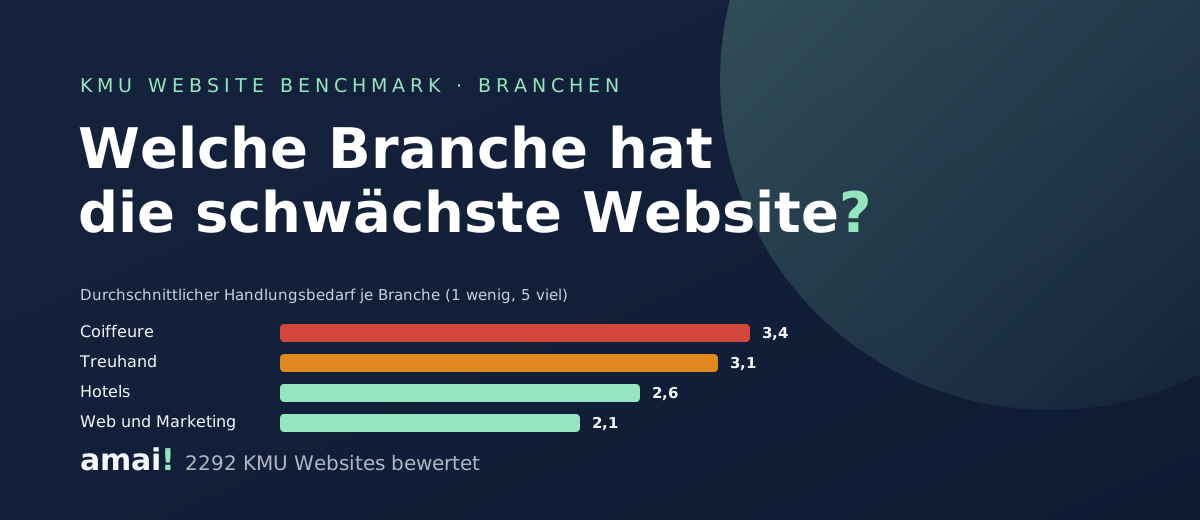
Which sector has the weakest websites?

Not every sector is equally far along digitally. In our review of 2292 Swiss SME websites, hairdressers, accountants and beauty studios score weakest on average. Best positioned are advertising and marketing firms and hotels. The gap runs through almost the whole SME landscape. It is not equally large everywhere though.
How we measured
The numbers come from our ongoing review of Swiss SME websites. Each site gets a rating on a scale of 1 to 5, where 5 means the greatest need for work and 1 an up to date presence. The rating is indicative and based on visible website elements. All the detail and the overall results are in the SME website study.
The ranking
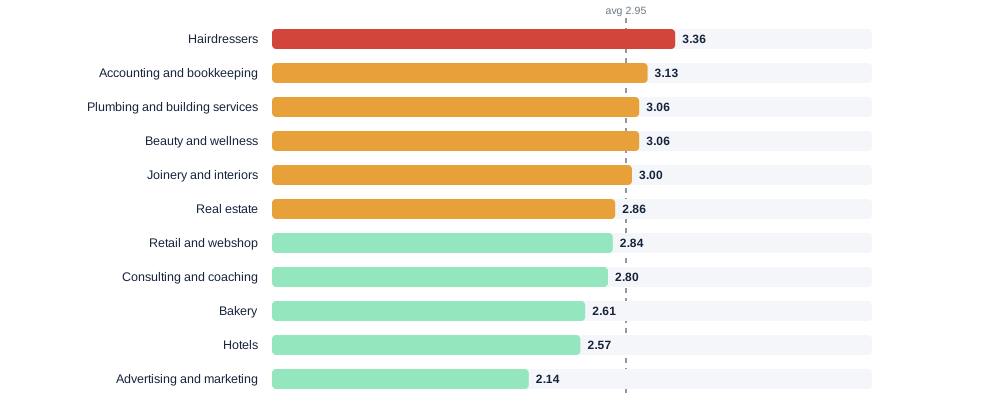
Average need for work per sector, from high to low:
- Hairdressers: 3.4. The greatest need in the field.
- Accounting and bookkeeping: 3.1.
- Plumbing and building services: 3.1.
- Beauty and wellness: 3.1.
- Joinery and interiors: 3.0.
- Real estate: 2.9.
- Retail and webshop: 2.8.
- Consulting and coaching: 2.8.
- Bakery: 2.6.
- Hotels: 2.6.
- Advertising and marketing: 2.1. The strongest presence in the field.
Where the weakest sectors fall short
For hairdressers and beauty studios the site often looks nicely photographed, yet thin in substance. There is no easy online booking, no clear prices and little text that Google and AI assistants can place. The business looks tidy but stays almost invisible to search.
For accounting and bookkeeping the weakness sits elsewhere. Trust is what counts here. That is exactly what falls short online: no faces, no references, barely any content explaining who the firm works for. On top of that a weak SEO base, so the site does not even come up for a concrete search.
For the trades like plumbing and joinery the most common fault is missing local findability and a contact that is not tappable on a phone. Whoever needs a tradesperson quickly is then gone.
Why advertising, marketing and hotels do better
No surprise that advertising and marketing firms have the strongest sites of their own. It is their craft. The site is their calling card. Hotels also do better because they have relied on booking, images and mobile friendliness for years. Both show what is possible when the website is taken seriously as a tool.
What your sector can do
- Hairdressers and beauty: an easy online booking, clear prices and a few sentences of text per service, so Google and AI can place you.
- Accounting and consulting: show faces, references and who you work for. Trust comes from specifics, not from empty phrases.
- Trades: put location and service in the page title and make the phone number tappable on mobile.
- Everyone: fill the page title and the meta description, add a preview image for shared links and answer on the homepage in two sentences what you offer and for whom.
The good news: no sector is hopelessly behind. The gap between the weakest and the strongest sector is smaller than you might think. Most of the gaps are fixed in a few hours with clean foundations.
We rate your website against the same grid as the study and tell you honestly where you stand and what the fastest first step is.
Request a free website analysis →Frequently asked questions
Which sector has the weakest websites? In our review of 2292 Swiss SME websites, hairdressers show the greatest need for work, followed by accounting and bookkeeping as well as beauty and wellness.
Which sector has the best websites? Advertising and marketing firms have the strongest sites of their own on average, followed by hotels and bakeries.
How large are the differences between sectors? Smaller than often thought. The average ranges from 2.1 to 3.4 on a scale of 5. The gap runs through almost every sector, only to a different degree.
What is the most common fault? Across all sectors SEO and content is the biggest weakness, closely followed by weak conversion, meaning no clear next step for visitors.
Tom de Vree · founder of amai
Tom de Vree builds and maintains websites, digital platforms and automations for Swiss SMEs.