Study: only 9% of Swiss SME websites are up to date

Fewer than one in ten Swiss SME websites is genuinely up to date. Of 2292 sites we reviewed, just under 9 percent reach the top tier. Around a third need real work. And when you look closely at those weakest sites, SEO and content is by far the biggest gap.
Why this study
At amai! we continuously review Swiss SME websites: structured, against a fixed grid and with the same criteria for every site. That has produced a dataset that gives an honest answer to a simple question: how fit are Swiss SME websites really?
Two layers, so the numbers stay honest
To keep the findings defensible, we separate two layers cleanly.
The first layer is a broad rating. We rated 2292 websites on a five-tier maturity scale, from up to date to urgent need. This rating covers the whole spectrum, from strong sites to weak ones.
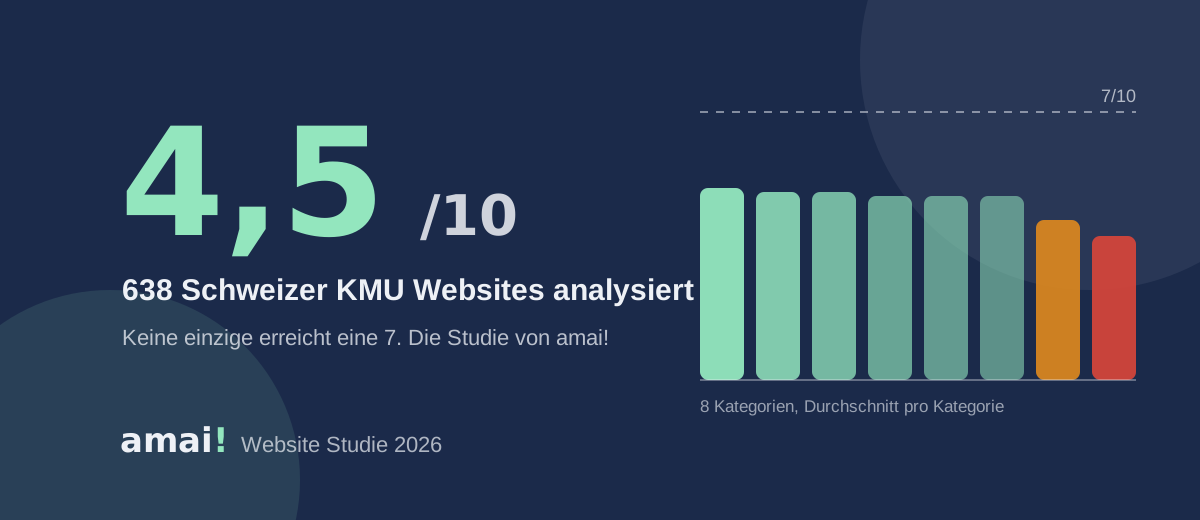
The second layer is a deep analysis. From the dataset we took the 638 sites with the greatest need and scored them between 14 June and 20 July 2026 across eight categories, from 0 to 10. The detailed scores further down therefore describe that weakest group specifically, not the average SME.
A fair note on scope: these are 2292 websites we compiled and rated for the Swiss market, across German-speaking Switzerland and many sectors. It is not a random sample from the commercial register. The rating is indicative and based on visible website elements, not on analytics or lab measurements. All results are anonymised and aggregated; no individual company is named.
The maturity of Swiss SME websites
Distribution across all 2292 reviewed sites on the five-tier scale:
- Up to date: 8.6 percent. Current presence, cleanly built, little to do.
- Solid: 27.4 percent. A good base with a few weak spots.
- Room to improve: 31.1 percent. Works but visibly leaves potential on the table.
- Needs work: 26.0 percent. Several weaknesses that cost customers.
- Urgent need: 7.0 percent. The site works against the business.
In short: 36 percent are solid or better, about a third sit in the middle and just under a third (33 percent) need real work. The average is 2.95 out of 5. Most Swiss SME websites are not a write-off. But only a small minority is up to date.

The 638 with the greatest need, across eight categories
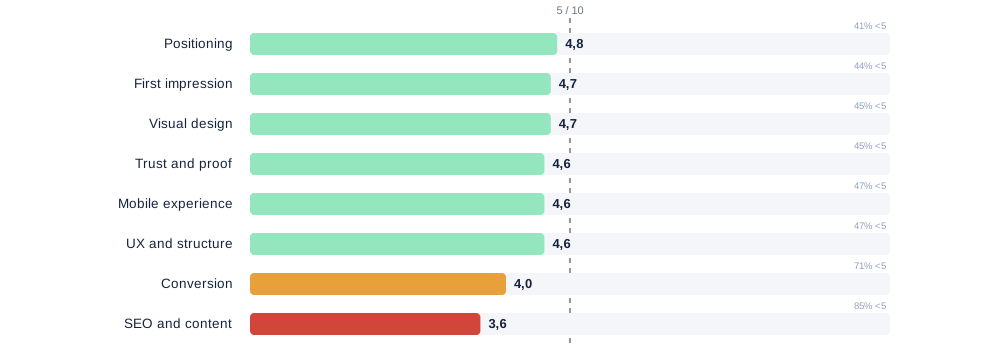
For the sites with the greatest need we looked closer. Average scores per category across those 638 websites:
- Positioning: 4.8 out of 10. 41 percent score below 5.
- First impression: 4.7 out of 10. 44 percent score below 5.
- Visual design: 4.7 out of 10. 45 percent score below 5.
- Trust and proof: 4.6 out of 10. 45 percent score below 5.
- Mobile experience: 4.6 out of 10. 47 percent score below 5.
- UX and structure: 4.6 out of 10. 47 percent score below 5.
- Conversion: 4.0 out of 10. 71 percent score below 5.
- SEO and content: 3.6 out of 10. 85 percent score below 5.
Three numbers sum up this group. Not one of the 638 sites reaches an overall average of 7. 90 percent do not reach a 7 in a single category. And 59 percent have at least one category at 3 points or lower, a problem that actively costs customers.
The biggest gap: invisible to Google and AI
SEO and content is by far the weakest category. 85 percent of these sites score below 5 and half sit at 3 or lower. For 40 percent it is the weakest category of all.
In practice that means page titles without service or location, missing or empty meta descriptions, barely any text explaining what the business offers and for whom. These sites often look tidy. Google and, increasingly, AI assistants can neither place them nor recommend them. The result is a presence that stays silent: technically online, practically invisible.
The second gap: visitors arrive, yet nothing happens
Conversion is the second weakest category at 4.0; 71 percent score below 5 and a quarter sit at 3 or lower. Typical patterns: no clear call to action, phone numbers as plain text instead of a tappable link, contact options that only appear after several clicks. Whoever makes it onto these sites often simply finds no easy next step.
Quick technical fixes that show results
Some problems came up again and again and are fixed in a few hours. At least 35 percent of these sites are missing an og:image, so shared links on WhatsApp or LinkedIn appear without a preview image. At least 29 percent have a generic or incomplete page title. At least 28 percent have a missing or empty meta description. On 15 percent, zooming on a phone is technically blocked. And on about 5 percent, the phone number is not tappable on mobile.
Not every sector is equally far along
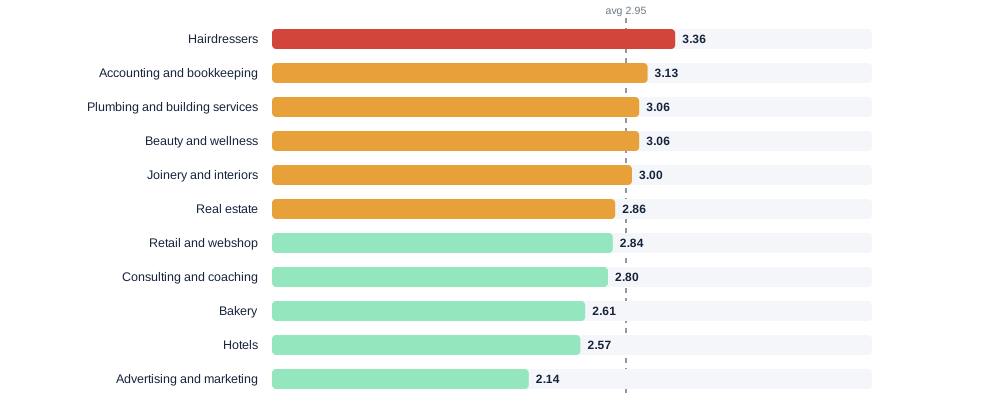
On the five-tier scale the average per sector ranges from 2.1 to 3.4 (higher means more need). The greatest need shows up among hairdressers at 3.4, followed by accounting and bookkeeping at 3.1 as well as beauty and wellness at 3.1. Best positioned are web and marketing at 2.1 and hotels at 2.6. The gap runs through almost the whole SME landscape. It is not equally large everywhere though.
Bern and Zurich compared
Between the larger cities the differences are small. In Zurich we reviewed by far the most sites (185), of which 9.7 percent are up to date. In Basel (90 sites) it is 5.6 percent, in Winterthur (60 sites) 11.7 percent. Bern stands out positively with 15.4 percent up to date sites, though on a smaller base of 39. The average sits close together everywhere, between 2.7 and 2.9 out of 5. So the gap is neither a big city problem nor a rural one. It runs through the whole of German speaking Switzerland.
What your SME can do tomorrow
The good news: almost all of it is fixed in a few hours. Five steps that work right away:
- Put service and location in the page title, for example Joinery in Aarau instead of just the company name.
- Fill the meta description of every important page with two clear sentences.
- Make the phone number tappable and put a visible call to action on the homepage.
- Add an og:image so shared links show a preview picture.
- Answer on the homepage in two sentences what you offer, for whom and why you.
Conclusion
Most Swiss SME websites are not a write-off. Almost all stay below their potential though: only just under 9 percent are up to date and a third need real work. That is good news for anyone who acts now. Get the basics right and you quickly reach the top of your sector.
Want to know where your website stands? We run exactly this analysis for your website free of charge: Request a free website analysis. Read more on the basics under SEO basics for SMEs and how we build websites that get found under Websites by amai!.
Tom de Vree · founder of amai
Tom de Vree builds and maintains websites, digital platforms and automations for Swiss SMEs.