A website that gets found on both sides of the Röstigraben

A carpenter in Biel, an accounting firm in Murten, a landscaper in Sierre. All three work right on the language border. Their customers speak German in the morning and French in the afternoon. Their website usually speaks only one language.
Day to day this hardly shows, because regular customers simply call. New customers search online first though. Someone in Bienne typing «menuisier» will never find the carpenter whose website exists only in German. The job goes to the competitor two streets away.
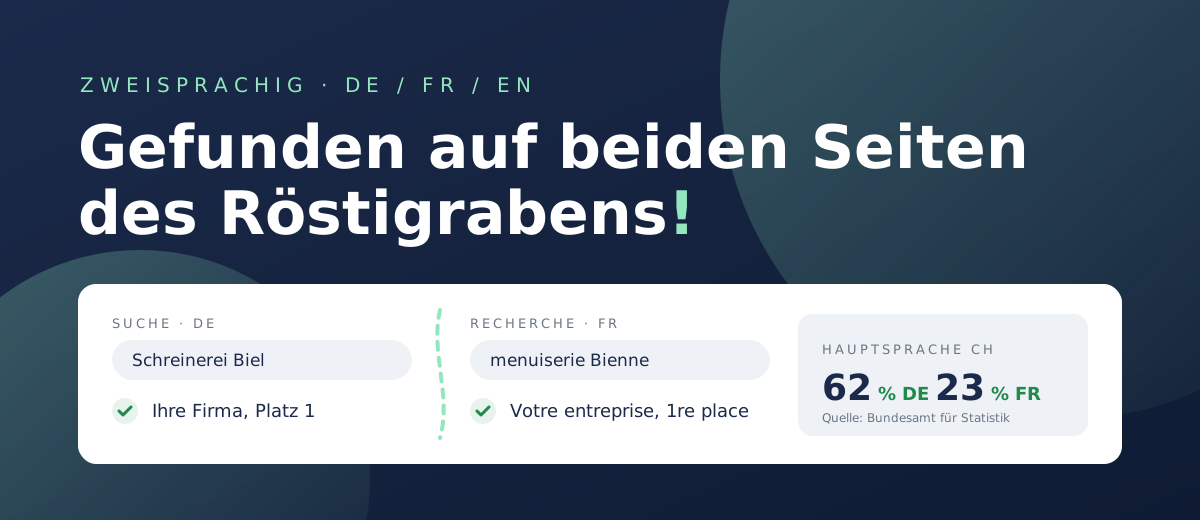
In short: a website gets found on both sides of the Röstigraben when each language has its own complete version at its own address (for example /de/ and /fr/). The copy has to be written in the language people search in, not just translated. Google needs technical signals telling it which pages belong together. Your Google Business Profile, your ads and your reviews need to cover both languages as well. Around 62 percent of the Swiss population mainly speak German and 23 percent French. Near the language border the share of the second language is often far higher.
Why does a single language website lose customers near the language border?
According to the Swiss Federal Statistical Office, French is the main language of almost one in four people in Switzerland. In Biel/Bienne, the largest bilingual city in the country, in the canton of Fribourg and in Valais, the market splits even more directly. A business that shows up in only one language is invisible to a large part of its own neighbourhood.
The reason is simple. Search engines show results in the language of the query. A page that only contains the word «Schreinerei» will not rank for «menuiserie». A good reputation does not change that.
Then there is trust. Many French speakers read German but would rather buy from someone who addresses them in their own language. The same holds the other way round. A quote in French after an enquiry in French looks like a business that listens.
Is a translation plugin enough for a bilingual website?
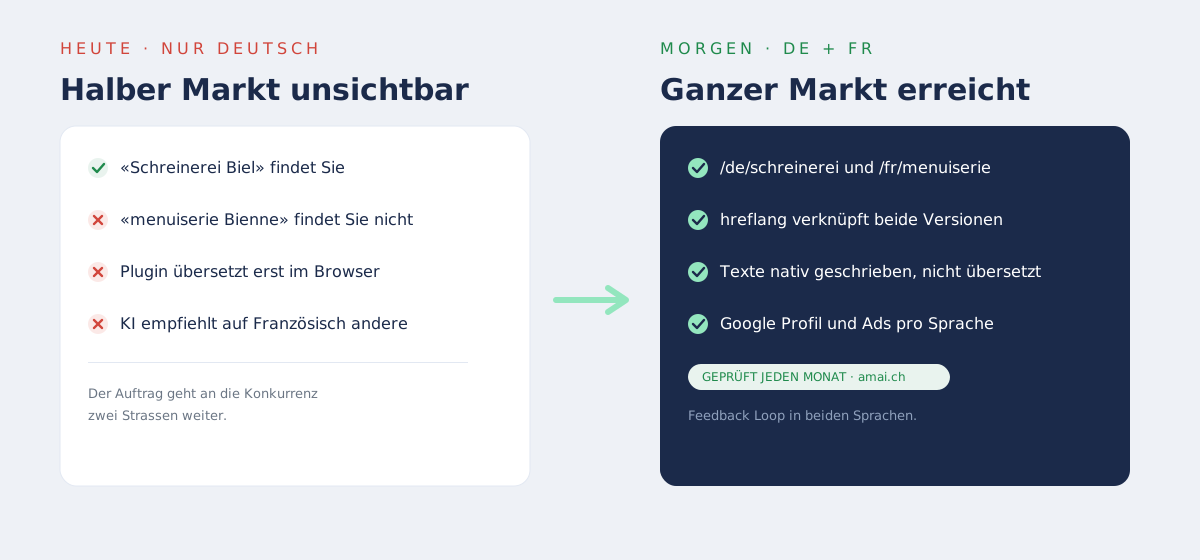
Rarely. Automatic translation plugins often lay the second language over the site as a layer. Sometimes Google never sees that version because it is only built in the browser. Sometimes the result reads in a way no native speaker would ever write.
The real issue is search terms. Someone in Fribourg who wants a new bathroom searches for «rénovation salle de bain Fribourg», not for a literal translation of your German headline. Technical terms, place names and phrasing all differ. A good French version therefore starts by asking how your customers actually search in French.
Machine translation now produces a usable first draft. After that, a native speaker needs to read it. At amai! we write every website natively in German, French and English. The three versions carry equal weight. None of them is an afterthought.
How does your website get found in both languages?
- Give each language its own addresses. For example yourcompany.ch/de/ and yourcompany.ch/fr/. Only then can Google index both versions separately and show the right one.
- Link the versions with hreflang. These invisible signals tell Google that /de/schreinerei and /fr/menuiserie are the same page in two languages. Without them your own pages compete against each other.
- Research search terms per language. Do not translate. Check which words people really type. Your service often has a completely different name in French.
- Translate the addresses and titles too. A French page living at /fr/badsanierung wastes potential. Title, description and image text belong in the matching language as well.
- Run your Google Business Profile in both languages. Description, services and posts in German and French. Ask customers from both language groups for reviews, since reviews also feed into search results.
- Split Google Ads campaigns by language. One campaign with German ads for German speaking users and a second one with French ads for French speakers. Mixed campaigns burn budget.
- Measure each language separately. How many visits, enquiries and rankings come from each version? Only then can you see whether the second language is pulling its weight.
The last step is what our Feedback Loop handles. Every month it checks how your site shows up on Google and whether ChatGPT and other AI assistants recommend you. We do this in both languages, because an AI asked in French relies mostly on French sources.
We check for free how your website performs for German and French searches. You will learn whether Google recognises both language versions correctly. You will also see which search terms you are missing in the second language.
Request a free website analysis →What does a bilingual website actually deliver?
First, a bigger market without driving an extra kilometre. A business in Biel that adds a French version suddenly reaches the Bernese Jura and Neuchâtel. An accounting firm in Fribourg can speak to both halves of the canton.
Second, less competition. In many trades bilingual SME websites are still the exception. A well built French version often ranks faster than the crowded German one.
Third, better enquiries. People who were informed in their own language call with clearer expectations. That saves you time in the first conversation.
What about AI answers in two languages?
ChatGPT, Perplexity and Google's AI Overviews answer in the language of the question. To build that answer they draw on sources in the same language. If someone asks in French for an electrician in Sierre, your French page is the one that counts.
The rules for AI match the rules for Google: clear answers to real questions, an FAQ in each language and consistent details on address, services and service area. A bilingual business that applies this consistently gets named in both language regions.
Frequently asked questions
Do I really need two complete websites? No. You need one website with two complete language versions on the same domain, for example /de/ and /fr/. That is easier to maintain than two separate sites. Each language version also benefits from the strength of the whole domain.
Is automatic translation good enough for Google? For a first draft yes, for good rankings rarely. Google does not automatically penalise machine translated text. It often misses the real search terms though. A native speaker of the target language should review every text and adapt it to local search.
What is hreflang and do I need it? hreflang is a technical signal in the code that tells Google which pages show the same content in different languages. Without it Google may show the wrong language version or treat both pages as competitors. Every multilingual website needs it.
Is a French version worth it for a business in Bern or Solothurn? Often yes. Many businesses in the canton of Bern also serve the Bernese Jura, Biel or the Neuchâtel region. Plenty of people living in German speaking Switzerland also prefer to search in French. A look at the search data quickly shows whether the demand is there.
How much does a bilingual website cost at amai? At amai a bilingual website is possible within the Website subscription from CHF 99 per month. We write the copy natively in German, French and English. We then maintain every version on an ongoing basis. Scope and exact price are agreed with each customer.
Tom de Vree · founder of amai
Tom de Vree builds and maintains websites, digital platforms and automations for Swiss SMEs.